Consumer Behaviour
What shapes the choices people make.
Before you start
Syllabus-checked revision — 44 questions with answers
The core set remains Q1–Q32. Additional answers Q33–Q44 below deepen the syllabus topics that needed more explanation. Expand the syllabus checklist at the end to locate each topic.
Based on the supplied MIM701A syllabus screenshots. Modules 1–2 carry 10% of questions each; Modules 3–6 carry 20% each. Module 4 has 12 teaching hours, so it needs broader coverage.
How to use: Expand one question at a time. Smaller overlapping questions have been folded into the relevant answer. For a short answer, use the definition and key points; for a longer answer, add the explanation, diagram or worked example. These are syllabus-based study groups, not predictions of the exam paper.
Module 1: Introduction to Consumer Behaviour — 10%
Q1. Define consumer behaviour and explain its scope, evolution and applications.
Definition: Consumer behaviour is the study of how individuals, groups and organisations select, buy, use and dispose of goods, services, ideas or experiences to satisfy their needs and wants. According to Schiffman and Kanuk, it is the behaviour consumers display in searching for, purchasing, using, evaluating and disposing of products and services that they expect will satisfy their needs.
Key points:
- Customer: the person who buys (and pays for) the product.
- Consumer: the person who actually uses the product; may or may not pay.
- Personal consumer: buys for own or family use.
- Organisational consumer: buys for a business, government or institution.
| Basis | Customer | Consumer |
|---|---|---|
| Meaning | Buys the product | Uses the product |
| Payment | Pays | May or may not pay |
| Example | Mother buys baby food | Baby consumes it |
Example: A father buys a cricket bat (customer) for his son, who plays with it (consumer).
Scope and evolution: Consumer behaviour covers need recognition, search, purchase, use, evaluation and disposal. It draws on psychology, sociology, anthropology and economics. Business emphasis developed from production and selling towards customer needs, relationships and digital interaction. Applications include segmentation, product design, pricing, communication and customer retention.
Q2. Explain segmentation, psychographics and their role in marketing strategy.
Introduction
No single product can satisfy every consumer, because people differ in needs, income and lifestyle. Market segmentation is the process of dividing a large, mixed market into smaller groups of consumers with similar needs, characteristics or behaviour, so that each group can be targeted with a suitable marketing mix.
1. Geographic Segmentation
Dividing the market by location.
- Variables: region, state, city size, climate, urban or rural area.
- Example: woollens for North India, light cotton clothing for the South.
2. Demographic Segmentation
Dividing the market by measurable population characteristics.
- Variables: age, gender, income, occupation, education, family size, life-cycle stage.
- Example: Horlicks variants for children, women and the elderly.
3. Psychographic Segmentation
Dividing the market by lifestyle, personality, values and social class.
- Variables: activities, interests, opinions, values.
- Example: Royal Enfield targets adventure-seekers.
4. Behavioural Segmentation
Dividing the market by how consumers behave towards the product.
- Variables: usage rate, benefits sought, brand loyalty, occasion, readiness to buy.
- Example: Cadbury "Kuch meetha ho jaaye" for festive occasions.
5. Requirements of Effective Segments
- Measurable – size and buying power can be measured.
- Substantial – large and profitable enough.
- Accessible – can be reached through media and distribution.
- Differentiable – responds differently from other segments.
- Actionable – the firm can design programmes for it.
6. Link with Consumer Behaviour
Segmentation is based on understanding how consumers differ in needs and behaviour. It is the first step of STP – Segmentation, Targeting and Positioning.
Advantages:
- Better understanding and satisfaction of customer needs.
- More effective use of the marketing budget.
- Helps find new market opportunities.
Limitations:
- Higher cost of research and multiple marketing mixes.
- Segments may be too small or may change over time.
Comparison Table
| Basis | Key question | Variables | Example |
|---|---|---|---|
| Geographic | Where do they live? | Region, climate, urban/rural | Woollens for North India |
| Demographic | Who are they? | Age, income, gender | Horlicks for children |
| Psychographic | How do they live? | Lifestyle, values | Royal Enfield |
| Behavioural | How do they buy/use? | Usage, loyalty, occasion | Festive Cadbury |
Memory aid: G-D-P-B – "Good Decisions Please Buyers."
Marketing strategy and psychographics: Consumer research guides segmentation → targeting → positioning → the 4Ps (product, price, place, promotion). Psychographics describes lifestyle, personality and values. AIO means activities, interests and opinions. VALS groups consumers by motivations and resources. Example: a fitness brand targets people interested in exercise, then selects relevant products, prices and media.
Q3. Explain attitude formation, its components and attitude change.
Introduction
Consumers do not judge products afresh each time; they carry ready-made likes and dislikes. Attitude is a learned predisposition to behave in a consistently favourable or unfavourable way towards an object such as a product, brand, store or idea.
1. Characteristics of Attitude
- Learned – formed through experience and information.
- Relatively consistent – stable over time.
- Has an object – a brand, product or idea.
- Has direction and intensity – favourable or unfavourable, strong or weak.
- Occurs within a situation – context can affect it.
2. Tri-Component (ABC) Model
- Cognitive component: knowledge and beliefs about the object ("This phone has a good camera").
- Affective component: feelings and emotions ("I love its design").
- Conative component: behaviour or intention to buy ("I will buy it next month").
Diagram loads when you reach it.
Diagram text
flowchart TD
    A["ATTITUDE"] --> C["Cognitive<br/>(Think)"]
    A --> F["Affective<br/>(Feel)"]
    A --> D["Conative<br/>(Do)"]
3. Sources of Attitude Formation
- Direct experience: product trial, free samples.
- Family and friends: word of mouth.
- Personality factors.
- Mass media and advertising.
- Learning: classical conditioning (pleasant music with a brand), operant conditioning (reward after purchase), cognitive learning (information).
4. Functions of Attitude (Katz)
- Utilitarian: towards products that are useful or rewarding.
- Ego-defensive: protects self-image.
- Value-expressive: shows the person's values.
- Knowledge: helps organise information.
Comparison Table
| Component | Meaning | Example |
|---|---|---|
| Cognitive | Beliefs | "Good camera" |
| Affective | Feelings | "I love the design" |
| Conative | Intention | "I will buy it" |
Example: After a free trial pack of a shampoo leaves her hair soft, a consumer forms a favourable attitude and buys the full bottle.
Memory aid: ABC = Affect, Behaviour, Cognition (Think – Feel – Do).
Changing attitudes: Improve product experience; correct inaccurate beliefs with evidence; change the importance attached to an attribute; introduce a useful new attribute; link the brand with a valued cause; or resolve conflicting needs, such as taste and health. Use strong arguments when buyers are highly involved and suitable emotional cues when attention is limited. An intention does not always become a purchase.
Q4. Explain the 7 Os and how marketers build customer satisfaction.
Definition: The 7 Os framework (Kotler) is a set of seven questions that helps marketers understand a market and its buyers.
Key points:
- Occupants – Who constitutes the market?
- Objects – What does the market buy?
- Objectives – Why does the market buy?
- Organisations – Who participates in buying?
- Operations – How does the market buy?
- Occasions – When does the market buy?
- Outlets – Where does the market buy?
| O | Question | Example (smartphones) |
|---|---|---|
| Occupants | Who? | Students, young professionals |
| Objects | What? | Phones with good camera and battery |
| Objectives | Why? | Communication, social media, status |
| Organisations | Who participates? | Self, parents, friends |
| Operations | How? | Online comparison, EMI, exchange offers |
| Occasions | When? | Festive sales, new launches |
| Outlets | Where? | E-commerce sites, brand stores |
Example: A phone brand uses the 7 Os to plan a festive-season online sale with EMI offers for college students.
Memory aid: Who, What, Why, Who-else, How, When, Where.
Building customer satisfaction: Compare perceived performance with expectations: below expectations leads to dissatisfaction; meeting them creates satisfaction; exceeding them may delight. Set realistic promises, deliver reliable quality and value, offer helpful after-sales service, resolve complaints and collect feedback. Satisfaction supports repeat purchase but does not guarantee loyalty.
Module 2: Factors Affecting Consumer Behaviour — 10%
Q5. Explain the factors influencing consumer behaviour with a diagram.
Introduction
No purchase happens in isolation; every buying decision is shaped by forces around the consumer and forces within the consumer. The factors influencing consumer behaviour are grouped into external (environmental) influences and internal (psychological / individual) influences.
Diagram:
Diagram loads when you reach it.
Diagram text
flowchart LR
    subgraph EXT["External influences"]
        E1["Culture"]
        E2["Subculture"]
        E3["Social class"]
        E4["Reference groups"]
        E5["Family"]
    end
    subgraph INT["Internal influences"]
        I1["Needs and motivation"]
        I2["Perception"]
        I3["Personality"]
        I4["Lifestyle"]
        I5["Values"]
        I6["Learning and memory"]
        I7["Beliefs and attitudes"]
    end
    EXT --> INT --> D["CONSUMER DECISION<br/>AND PURCHASE"]
1. External Influences
These come from the consumer's social and cultural environment.
- Culture: the values, beliefs, customs and behaviour learned from society. Example: demand for gold during Akshaya Tritiya and Dhanteras.
- Subculture: smaller groups within a culture based on religion, region, language or age. Example: Durga Puja shopping among Bengali consumers.
- Social class: relatively permanent divisions of society based on income, occupation, education and wealth; each class has similar buying patterns.
- Reference groups: groups a person uses as a standard – friends, colleagues, celebrities.
- Family: the most important buying unit; shapes values, brand preferences and buying roles.
2. Internal Influences
These come from within the individual.
- Needs and motivation: unmet needs create tension that motivates purchase.
- Perception: how a consumer selects and interprets information about products.
- Personality: inner traits that lead to consistent responses (confident, sociable).
- Lifestyle: pattern of living shown in activities, interests and opinions (AIO).
- Values: enduring beliefs about what is important (health, family, status).
- Learning: changes in behaviour from experience.
- Memory: stored information used in decisions.
- Beliefs and attitudes: what consumers think and feel about brands.
Comparison Table
| Basis | External influences | Internal influences |
|---|---|---|
| Source | Society and environment | The individual's mind |
| Examples | Culture, class, family, groups | Motivation, perception, personality |
| Control by consumer | Low | Higher |
| Marketing use | Segmentation, cultural themes | Product appeals, ad messages |
Example: A young professional buys a premium smartwatch because her friends use one (reference group), she values fitness (lifestyle) and sees it as a status symbol (perception).
Memory aid (external): "Cute Sisters Sing Really Fine" – Culture, Subculture, Social class, Reference groups, Family.
Q6. Explain memory, lifestyle, beliefs, attitudes and values.
Definition: Memory is the process of acquiring, storing and retrieving information for later use. Consumers rely on memory to recall brands when they decide what to buy.
Diagram loads when you reach it.
Diagram text
flowchart LR
    S["Stimulus"] --> SM["Sensory memory<br/>(fraction of a second)"] --> ST["Short-term memory<br/>(working memory, a few seconds)"]
    ST -- "rehearsal / repetition" --> LT["Long-term memory<br/>(large capacity; retention varies)"]
    LT -- retrieval --> ST
Key points:
- Sensory memory: brief impression from the senses.
- Short-term (working) memory: limited capacity; information is processed here.
- Long-term memory: relatively durable storage; brand knowledge is kept here.
- Marketing implications: repetition of ads and jingles, chunking information, memorable brand names and logos, mnemonics and consistent brand colours help consumers recall brands at the point of purchase.
Example: A catchy jingle repeated on TV helps shoppers recall the brand when they see it on the shelf.
Related internal influences: Lifestyle is a person's pattern of living, often described through AIO. A belief is what someone thinks is true about a product; an attitude is their favourable or unfavourable evaluation; a value is a broader guiding principle. Example: valuing health may shape beliefs about ingredients, attitudes to a snack and buying habits.
Information processing: Exposure makes information available; attention selects part of it; comprehension gives it meaning; acceptance integrates it with beliefs; encoding/storage makes it available in memory; retrieval brings it back when needed. Forgetting, interference and retrieval failure can occur. Example: a shopper notices an ad, understands a warranty claim, connects it with the brand and recalls it during comparison.
Module 3: Social and Cultural Environment — 20%
Q7. Explain culture, subculture, cultural change and cross-cultural marketing.
Introduction
What we eat, wear, celebrate and value is largely shaped by the society we grow up in. According to Schiffman, culture is the sum total of learned beliefs, values, customs, knowledge, art and behaviour shared by members of a society and passed from one generation to the next.
1. Characteristics of Culture
- Learned: acquired from family, school and society – not inborn.
- Shared: common to members of a group.
- Transmitted: passed from generation to generation.
- Dynamic: changes over time (e.g., acceptance of online shopping).
- Satisfies needs: provides guidelines for eating, dressing and behaving.
- Invisible hand: influences us without our noticing.
- Adaptive and integrated: its elements fit together into a whole.
2. Elements of Culture
Values, norms, customs, rituals, symbols, language and religion.
3. Relevance to Marketing Decisions
- Product: McDonald's in India offers the McAloo Tikki, vegetarian options and no beef products.
- Communication: ads use regional languages, festivals and family themes.
- Colours and symbols: white for mourning in some cultures; red for weddings in India.
- Timing: sales during Diwali, Durga Puja, Eid and Christmas.
- Packaging and pricing: festival gift packs, small sachets.
- Avoiding offence: respecting religious and cultural sensitivities.
Comparison Table
| Marketing decision | Cultural influence | Example |
|---|---|---|
| Product | Food habits, religion | McAloo Tikki |
| Promotion | Language, festivals | Regional-language Diwali ads |
| Packaging | Colours, gifting customs | Festive gift boxes |
| Timing | Festival calendar | Durga Puja sales |
Example: Cadbury links its chocolates with Indian festivals and family celebrations through the "Kuch meetha ho jaaye" theme.
Values, change and cross-cultural influence: Cultural values guide what a society considers desirable. Changes in work, family roles and environmental concerns can change demand. Subcultures share distinctive patterns within a wider culture, for example regional, religious or generational groups. Cross-cultural marketing compares meanings, customs, language and consumption habits across cultures; adapt products and messages rather than assume identical responses.
Q8. Explain economic, demographic and social-class influences.
Introduction
Every society has people at different levels of wealth and status. Social stratification is the division of society into hierarchical layers (social classes) based on wealth, income, occupation, education and status. A social class is a group of people with similar status, values, lifestyles and behaviour.
1. Determinants of Social Class
Income, occupation, education, wealth, family background and place of residence.
2. Features of Social Class
- Hierarchical: upper, middle and lower.
- Relatively permanent: but mobility (upward or downward) is possible.
- Multi-dimensional: not based on income alone.
- Similar consumption patterns among members.
3. Influence on Buying Behaviour
- Upper class: luxury and premium brands, exclusivity, foreign travel, quality over price.
- Middle class: value for money, branded but affordable products, spending on education, EMIs.
- Lower class: price-sensitive, essentials, local brands, small packs, immediate needs.
4. Marketing Uses
- Segmentation by class.
- Product and price levels (economy vs premium variants).
- Store choice and media selection.
- Advertising themes.
Indian measure: the New Consumer Classification System (NCCS) groups households by the chief earner's education and ownership of durables (A1 … E3).
Comparison Table
| Class | Buying behaviour | Example |
|---|---|---|
| Upper | Luxury, exclusivity | Mercedes, foreign holidays |
| Middle | Value-for-money brands, EMIs | Maruti, mid-range phones |
| Lower | Price-sensitive, small packs | Sachets, local brands |
Example: Hindustan Unilever sells premium Dove for upper-class buyers and low-priced Lifebuoy sachets for price-sensitive buyers.
Economic and demographic influences: Income, purchasing power, prices and employment affect affordability. Age, education, occupation, household size and life stage affect needs and media use. Social class is broader than income alone and can influence aspirations, store choice and preferences; avoid assuming everyone in a class behaves identically.
Q9. Explain reference groups, personal influence and opinion leadership.
Introduction
People often look to others before deciding what to buy or wear. A reference group is any person or group that serves as a point of comparison or reference for an individual in forming attitudes, values or behaviour.
1. Types of Reference Groups
- Primary group: small, frequent face-to-face contact – family, close friends.
- Secondary group: less frequent, more formal contact – clubs, professional bodies.
- Formal group: defined structure and rules – college committee, company.
- Informal group: loose, friendship-based – friends circle, gym buddies.
- Membership group: the person belongs to it – classmates.
- Aspirational group: the person wants to belong to it – cricket stars, successful entrepreneurs.
- Dissociative group: the person avoids being associated with it.
- Virtual / online group: Instagram influencers, online communities.
2. Types of Reference Group Influence
- Informational influence: seeking expert advice (asking a tech-savvy friend about laptops).
- Utilitarian (normative) influence: complying to gain approval or avoid rejection (wearing branded shoes because friends do).
- Value-expressive influence: buying to express a desired self-image (using a brand linked with an admired celebrity).
3. Factors Affecting the Degree of Influence
- Visibility of the product (clothes and cars are more influenced).
- Consumer's own experience and knowledge.
- Credibility and power of the group.
- Consumer's need for conformity.
4. Marketing Applications
Celebrity endorsements, expert endorsements (doctors for toothpaste), common-person testimonials, influencer marketing and brand communities.
Comparison Table
| Influence | Consumer's motive | Example |
|---|---|---|
| Informational | Wants correct information | Asking a friend about laptops |
| Utilitarian | Wants approval / avoid rejection | Same sneakers as friends |
| Value-expressive | Wants a desired self-image | Using a celebrity's brand |
Example: Many young consumers buy a sports brand because their favourite cricketer endorses it (aspirational group, value-expressive influence).
Personal influence and opinion leadership: Advice, word of mouth and recommendations affect choices. An opinion leader is influential in a particular product category because of experience, credibility or expertise. Influence can be informational (useful evidence), normative (approval) or value-expressive (identity). A knowledgeable friend's phone recommendation is an example.
Q10. Explain family roles, structure, life cycle and changing purchase decisions.
Introduction
Many purchases are made for or by the family. A family is two or more persons related by blood, marriage or adoption who live together. It is the most important consumer buying unit and the first source of consumer socialisation, where children learn buying skills and brand preferences.
1. Structure of the Family
- Nuclear family: parents and children.
- Joint / extended family: grandparents, parents, uncles and children together (common in India).
- Single-parent families and single-person households: growing in cities.
2. Functions of the Family
- Economic well-being.
- Emotional support.
- A suitable family lifestyle.
- Consumer socialisation of children.
3. Buying Roles Within the Family
- Initiator: suggests the idea (child wants a smart TV).
- Influencer: gives advice (elder sibling recommends a brand).
- Decider: makes the final decision (father or mother).
- Buyer: actually purchases (father orders online).
- User: uses the product (whole family).
- Gatekeeper: controls the flow of information (mother filters which offers are considered).
4. Types of Husband–Wife Decisions
- Husband-dominated: e.g., car, insurance (traditionally).
- Wife-dominated: e.g., kitchen items, groceries, children's clothing.
- Joint (syncratic): house, holidays, furniture.
- Autonomic: either spouse decides independently – personal items.
Comparison Table
| Role | Who (TV purchase) |
|---|---|
| Initiator | Child |
| Influencer | Elder sibling |
| Decider | Parents |
| Buyer | Father |
| User | Whole family |
| Gatekeeper | Mother |
Family life cycle and change: Typical stages include single adults, newly formed households, households with children, older households and solitary survivors; actual families follow varied paths. Needs shift from education and household setup to childcare, savings and later-life services. Joint/nuclear structures, dual incomes, children's influence and changing gender roles affect who initiates, influences, decides, buys and uses a product.
Module 4: Motivation, Personality, Perception and Learning — 20%; 12 hours
Q11. Explain needs, goals, motivation and motive arousal.
Introduction
Every purchase begins with a reason to buy. According to Schiffman, motivation is the driving force within individuals that impels them to action. It is produced by a state of tension caused by an unfulfilled need; people buy products to reduce this tension.
1. The Motivation Process
- An unfulfilled need creates tension.
- Tension produces a drive to act.
- The drive leads to behaviour (searching and buying).
- Behaviour achieves a goal, which fulfils the need and reduces tension.
- Learning and cognitive processes shape which behaviour and goal are chosen.
Diagram loads when you reach it.
Diagram text
flowchart LR
    A["Unfulfilled needs,<br/>wants and desires"] --> B["Tension"] --> C["Drive"] --> D["Behaviour<br/>(buying)"] --> E["Goal or need<br/>fulfilment"] --> F["Tension<br/>reduction"]
    G["Learning"] --> A
    H["Cognitive processes"] --> G
    D --> H
2. Types of Needs
- Innate (primary / biogenic) needs: physiological – food, water, shelter, clothing.
- Acquired (secondary / psychogenic) needs: learned from culture and environment – esteem, prestige, affection, power.
3. Goals
Goals are the sought-after results of motivated behaviour.
- Generic goal: a general category that satisfies a need ("I want a phone").
- Product-specific goal: a specific brand or product ("I want an iPhone 17").
- Positive goals: objects people approach (healthy food).
- Negative goals: objects people avoid (avoiding sugar).
4. Rational vs Emotional Motives
- Rational motives: objective criteria – price, size, fuel efficiency.
- Emotional motives: subjective criteria – pride, love, fear, status.
5. Features of Needs and Goals
- Needs are never fully satisfied.
- New needs arise when old ones are met.
- Success and failure change the level of aspiration.
- One goal may satisfy many needs.
- Substitute goals are used when the preferred goal is blocked.
Comparison Table
| Basis | Innate needs | Acquired needs |
|---|---|---|
| Origin | Biological | Learned from society |
| Also called | Primary, biogenic | Secondary, psychogenic |
| Examples | Food, water, shelter | Status, affection, power |
Example: A student feels hungry (need), becomes restless (tension), orders a pizza (behaviour) and feels satisfied (tension reduction).
Motive arousal: Needs may be activated physiologically (hunger), emotionally (desire for belonging), cognitively (thinking about a future goal), or environmentally (seeing an advertisement). Motivation theories are compared in the next answer.
Q12. Compare the motivation theories named in the syllabus.
Motivation theories explain needs, expectations and motives. Revise the following as one comparison, then expand the requested theory in an exam.
| Theory | Essential points | Example / distinction |
|---|---|---|
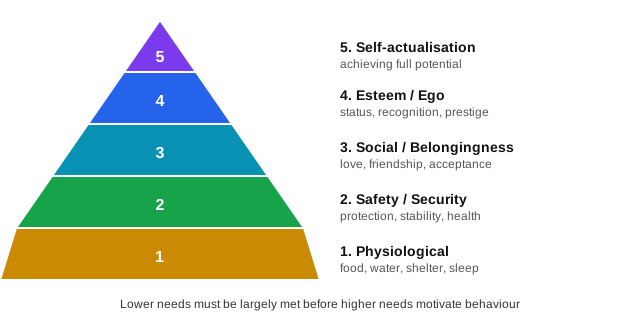
| Maslow | Physiological → safety → belonging → esteem → self-actualisation | Food, protection, friendship, recognition, personal growth; the hierarchy is a framework, not a rigid universal purchasing rule |
| Alderfer ERG | Existence, relatedness, growth; several needs may operate together; frustration–regression | Blocked growth may increase attention to relationships or material needs |
| Herzberg | Hygiene factors prevent dissatisfaction; motivators generate satisfaction | Originally a workplace theory; product basics versus delight factors is an analogy |
| McClelland | Learned needs for achievement, affiliation and power | Appeals to accomplishment, belonging or influence |
| McGregor X/Y | X assumes people need external direction; Y emphasises self-direction and responsibility under suitable conditions | Managerial assumptions, not fixed types of consumers |
| Vroom | Motivation = expectancy × instrumentality × valence | Belief effort produces performance × belief performance brings an outcome × value of that outcome |
| Porter–Lawler | Reward value and perceived effort–reward probability affect effort; ability and role clarity affect performance; rewards and perceived fairness affect satisfaction | Effort alone does not guarantee performance or satisfaction |
| Freud | Unconscious motives; id seeks pleasure, superego represents moral standards, ego mediates realistically | Symbolic meanings of products; explanations are interpretive, not certain diagnoses |
Vroom example: 0.7 × 0.9 × 0.8 = 0.504. If one factor is zero, the multiplicative score is zero. This is an illustrative score, not a purchase probability.
Diagram to practise: Maslow's five levels from basic needs to self-actualisation.
Q13. Explain personality, its determinants, development and measurement.
Introduction
Two consumers with the same income may buy very different brands because they are different kinds of people. According to Schiffman, personality is the set of inner psychological characteristics that both determine and reflect how a person responds to their environment.
1. Nature of Personality
- Reflects individual differences: no two people are exactly alike, though groups may share traits.
- Consistent and enduring: relatively stable over time.
- Can change: due to major life events or gradual maturity.
2. Determinants of Personality
- Heredity (biological): inherited traits such as physique, temperament and intelligence.
- Environment: the surroundings in which a person grows up.
- Family: parents' behaviour, upbringing, birth order and family values.
- Culture: values and norms of society (individualism vs collectivism).
- Social / reference groups: friends, school and peer groups.
- Situation: specific circumstances can bring out different traits.
- Life experiences: success, failure, education and travel.
3. Marketing Relevance
Consumers choose brands whose brand personality matches their own – for example, Thums Up = bold and adventurous; Dove = gentle and caring.
Comparison Table
| Determinant | Type | Example of influence |
|---|---|---|
| Heredity | Biological | Energetic temperament |
| Family | Social | Thrifty habits learned from parents |
| Culture | Social | Collectivist values |
| Situation | Environmental | Confident at work, shy at parties |
Example: An adventurous young man is drawn to Thums Up's "Toofani" image because it matches his bold personality.
Development and measurement: Personality develops through interaction between heredity, family, culture, learning, experience and situations. Measurement uses self-report inventories, rating scales, observation, interviews and projective techniques. Responses can be biased; personality does not determine each purchase on its own.
How personality is measured: Define the trait being studied, choose an appropriate validated inventory or observation method, collect responses consistently, score them according to the instrument, and interpret them with attention to reliability, validity and the setting. Self-report questionnaires are convenient but can suffer from socially desirable responding; projective interpretations are subjective and should not be treated as definitive. Development reflects continuing interaction between biological dispositions, socialisation and experience, so a trait profile is neither a permanent label nor a complete purchase prediction.
Q14. Compare the personality theories in the syllabus.
Introduction
Psychoanalytic theories explain personality through inner conflicts and unconscious forces. Sigmund Freud founded this approach, and his followers, the Neo-Freudians, modified it by stressing social relationships.
1. Psychoanalytic Theory (Sigmund Freud)
- Personality results from the interaction of the id, ego and superego.
- Unconscious needs, especially biological drives, are central to motivation and personality.
- Personality develops through psychosexual stages in childhood – oral, anal, phallic, latency, genital.
- Marketing use: symbolism in ads, motivation research, products that satisfy hidden desires.
2. Neo-Freudian Theory
Freud's followers believed social relationships, not sexual instincts, are fundamental to personality.
- Alfred Adler: people strive to overcome feelings of inferiority ("style of life").
- Harry Stack Sullivan: people seek significant relationships to reduce anxiety.
- Karen Horney – CAD model: people are classified as Compliant, Aggressive or Detached.
Comparison Table (Horney's CAD model)
| Type | Behaviour | Consumer tendency |
|---|---|---|
| Compliant | Moves towards others; wants love and approval | May be receptive to social-acceptance appeals |
| Aggressive | Moves against others; wants power and success | May be receptive to achievement or influence appeals |
| Detached | Moves away from others; wants independence | May be receptive to autonomy or independence appeals |
Example: A marketer might contrast messages about belonging with messages about independence. These are illustrative appeals, not reliable predictions of an individual's purchase.
Memory aid: CAD = Compliant (towards), Aggressive (against), Detached (away).
Other syllabus theories: Self-concept links purchases to actual self, ideal self, social self and ideal social self. Trait theory describes relatively enduring measurable characteristics, such as innovativeness. Humanistic theory emphasises growth and self-actualisation. Social-cognitive theory explains reciprocal influence between person, behaviour and environment, including self-efficacy. These complement psychoanalytic and Neo-Freudian explanations.
Q15. Explain perception and the stages of the perceptual process.
Introduction
Consumers are surrounded by thousands of stimuli every day, but they notice and remember only a few. The perceptual process explains how a stimulus is received, noticed, organised, understood and remembered.
Diagram:
Diagram loads when you reach it.
Diagram text
flowchart LR
    A["EXPOSURE<br/>stimulus reaches senses"] --> B["ATTENTION<br/>focus on some stimuli"] --> C["ORGANISATION<br/>arrange into patterns"] --> D["INTERPRETATION<br/>give meaning"] --> E["RETENTION<br/>store in memory"]
Stages of the Perceptual Process
- Exposure: a stimulus comes within range of the senses (seeing a billboard, hearing a jingle). Consumers practise selective exposure – they seek pleasant or useful messages and avoid others (skipping ads).
- Attention: the consumer focuses mental effort on some stimuli. Attention is drawn by size, colour, contrast, movement, novelty, position, celebrities and personal relevance.
- Organisation: stimuli are grouped into meaningful wholes using Gestalt principles:
- Figure and ground: the product (figure) should stand out from the background.
- Grouping: items placed together are seen as related (product + lifestyle).
- Closure: people complete incomplete pictures (partial logos, unfinished jingles).
- Interpretation: giving meaning to stimuli based on experience, expectations, culture and motives; different consumers may interpret the same ad differently.
- Retention: storing the interpreted information in memory; consumers remember messages consistent with their beliefs (selective retention).
Comparison Table
| Stage | What happens | Marketing tip |
|---|---|---|
| Exposure | Stimulus reaches senses | Place ads where the target audience is |
| Attention | Consumer focuses | Use colour, contrast, novelty |
| Organisation | Grouping into patterns | Use figure–ground, closure |
| Interpretation | Meaning given | Keep the message clear |
| Retention | Stored in memory | Repeat, use jingles |
Example: A bright yellow billboard (attention) showing an incomplete famous logo (closure) makes drivers notice and remember the brand.
Memory aid: "Every Apple Orchard Is Ripe" – Exposure, Attention, Organisation, Interpretation, Retention.
Meaning and importance: Perception is how consumers select, organise and interpret sensory information. It is subjective and selective, so the same price, package or advertisement may mean different things to different people. Perception shapes attention, brand image, perceived quality, risk and value.
Q16. Explain sensory elements, thresholds and barriers to accurate perception.
Introduction
Perception begins when our senses receive a stimulus. The basic elements of perception explain when consumers notice a stimulus and how much change is needed before they notice a difference.
1. Sensation
The immediate response of the sense organs (eyes, ears, nose, mouth, skin) to simple stimuli such as an ad, a package or a sound. Sensory adaptation means getting used to a stimulus so that it is no longer noticed – so marketers change ads regularly.
2. Absolute Threshold
The lowest level at which a person can detect a stimulus – the point between "nothing" and "something". Example: the distance at which a driver can just notice a billboard.
3. Differential Threshold / Just Noticeable Difference (JND)
The minimum difference between two stimuli that can be detected.
4. Weber's Law
The stronger the initial stimulus, the greater the additional change needed for the difference to be noticed. The JND is a constant proportion of the original stimulus.
(K = constant, ΔI = smallest noticeable change, I = initial intensity)
Numerical Example
Given: price of a chocolate I = ₹50; JND constant K = 0.10.
To find: smallest noticeable price change ΔI.
Formula: ΔI = K × I
Solution: ΔI = 0.10 × 50 = ₹5
Answer: ₹5.
Interpretation: under the illustrative assumption, ₹5 is the estimated just-noticeable change. Real price noticing depends on context; Weber's law is an approximation, not a guaranteed rule for shoppers.
5. Marketing Applications of JND
- Below the JND: reduce pack size, raise price or update logos gradually (shrinkflation, gradual logo evolution) so negative changes are not noticed.
- Above the JND: make improvements, discounts and "20% extra" offers large enough to be noticed.
Comparison Table
| Element | Meaning | Example |
|---|---|---|
| Sensation | Immediate sensory response | Hearing a jingle |
| Absolute threshold | Minimum detectable level | Distance to notice a billboard |
| JND | Minimum noticeable difference | ₹5 on a ₹50 chocolate |
| Weber's law | JND is a constant proportion | Bigger price needs bigger change |
Sensory dynamics and barriers: Sight, sound, smell, taste and touch influence product experience. Barriers include selective attention, selective distortion, selective retention, stereotypes, halo effects, information overload and perceptual defence. Example: attractive packaging may create an unjustified impression of superior product quality.
Sensory dynamics: Colour and shape affect visual impressions; music and sound affect atmosphere; scent can cue memories; texture affects perceived quality; taste affects food evaluation. Match sensory cues to the intended positioning and test responses instead of assuming one universal effect.
Perceptual barriers: Selective attention filters out much information; distortion interprets a message through existing beliefs; selective retention favours some information in memory; perceptual defence avoids threatening messages; stereotyping applies group assumptions; the halo effect generalises one impression to other attributes. Reduce misunderstanding through clear claims, accessible design, credible evidence and consistent product experience.
Q17. How does perception affect consumer decision-making? Explain perception of products and brands, price, risk and advertising.
Introduction
Consumers decide on the basis of what they perceive, not on objective facts. Perception shapes how they judge products and brands, prices, risks and advertisements, and therefore what they finally buy.
1. Perception of Products and Brands
- Consumers use intrinsic cues (size, colour, taste, ingredients) and extrinsic cues (price, brand name, packaging, store image, country of origin).
- Positioning creates a distinct perception (Volvo = safety; Amul = the taste of India).
- Brand image and perceived quality drive preference.
2. Perception of Price
- Perceived value: what consumers believe they get for what they pay.
- Reference price: the price used for comparison ("MRP ₹999, now ₹699").
- Price–quality relationship: a higher price is often seen as higher quality, especially when few other cues exist.
- Psychological (odd) pricing: ₹499 feels much cheaper than ₹500.
- Perceived fairness: sudden price hikes are seen as unfair.
3. Perception of Risk
Perceived risk is the uncertainty consumers feel when they cannot predict the results of a purchase.
- Functional risk: the product may not work.
- Financial risk: money may be wasted.
- Physical risk: harm to health or safety.
- Social risk: embarrassment before others.
- Psychological risk: damage to self-image.
- Time risk: time lost if the product fails.
How consumers reduce risk: seek information and reviews, stay brand loyal, buy well-known brands, rely on store image, buy the most expensive model, buy small quantities, look for warranties, return policies and free trials.
How marketers reduce risk: guarantees, free samples, money-back offers, testimonials, certifications (ISI, FSSAI) and demonstrations.
4. Perception and Advertising
- Ads must first gain exposure and attention, then be interpreted correctly.
- Key factors: source credibility, message clarity, repetition, music, celebrities, humour, emotional appeals.
- Perception of the ad affects attitude towards the ad and the brand, and finally purchase.
- Misleading ads damage trust once detected.
Comparison Table (types of perceived risk)
| Type of risk | Meaning | Example |
|---|---|---|
| Functional | Product may not work | New phone brand may fail |
| Financial | Money wasted | Expensive laptop |
| Physical | Harm to health | New medicine |
| Social | Embarrassment | Unfashionable clothes |
| Psychological | Damage to self-image | Wrong luxury brand |
| Time | Time lost | Returning a faulty product |
Example: An online seller offers a 10-day free return policy to reduce the financial and functional risk of buying shoes without trying them on.
Q18. Explain perceptual mapping, consumer imagery and subliminal perception.
Introduction
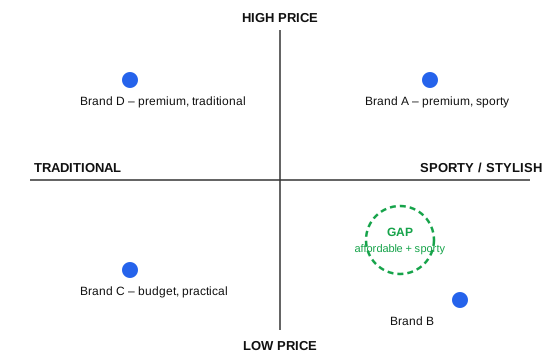
Marketers need to know where their brand stands in consumers' minds compared with competitors. Perceptual mapping is a visual technique that shows how consumers perceive competing brands on two or more important attributes. It helps marketers understand positioning and find gaps in the market.
1. Steps in Perceptual Mapping
- Identify key attributes through consumer research.
- Collect consumer ratings of each brand on these attributes.
- Plot the brands on a two-axis graph.
- Interpret clusters, close competitors and gaps.
2. Diagram – Car Brands on Price and Style (illustrative positions)
3. Uses of Perceptual Mapping
- Understand how consumers see your brand versus competitors.
- Identify market gaps for new products (an affordable sporty car).
- Plan repositioning if the brand is in the wrong place.
- Track changes in perception over time.
Advantages:
- Simple visual view of competition.
- Reveals new product opportunities.
Limitations:
- Based on perceptions, which may change.
- Two axes simplify reality.
Comparison Table
| Brand | Price | Style | Position |
|---|---|---|---|
| A | High | Sporty | Premium sporty |
| B | Low | Slightly sporty | Budget |
| C | Low | Traditional | Budget practical |
| D | High | Traditional | Premium traditional |
Example: If the map shows no brand in the "affordable and sporty" area, a company may launch a low-priced sporty hatchback.
Consumer imagery and subliminal perception: Consumer imagery is the mental picture of a brand, product, store or service, formed by experience and marketing cues. Subliminal perception concerns stimuli below conscious awareness; do not claim it reliably controls purchases. A perceptual map uses consumers' perceived attributes, not necessarily objective product measurements.
Types of consumer imagery: Product/brand image concerns associated qualities and symbolic meanings; store image concerns assortment, service and atmosphere; service image draws on staff, processes and physical cues; price–quality imagery concerns what a price suggests about quality; corporate image concerns the organisation's reputation. Images can differ from objective performance, so research the audience's actual associations.
Subliminal versus ordinary persuasion: Subliminal stimuli are presented below conscious awareness; subtle but consciously detectable design is not automatically subliminal. Do not infer reliable buying control from laboratory effects or popular claims. Consumer choice also depends on existing needs, attention, context and alternatives.
Q19. Explain learning and classical conditioning with marketing examples.
Introduction
Classical conditioning, developed by Ivan Pavlov, is learning by association. A neutral stimulus, repeatedly paired with a stimulus that naturally produces a response, starts producing a similar response on its own. It is a form of stimulus–response learning.
1. Pavlov's Experiment
| Stage | Stimulus | Response |
|---|---|---|
| Before | Food (UCS) Bell (neutral) | Salivation (UCR) No response |
| During (repeated pairing) | Bell (CS) + Food (UCS) | Salivation (UCR) |
| After | Bell (CS) alone | Salivation (CR) |
- Unconditioned stimulus (UCS): naturally causes a response (food).
- Unconditioned response (UCR): the natural response (salivation).
- Conditioned stimulus (CS): a neutral stimulus that becomes linked (bell).
- Conditioned response (CR): the learned response to the CS (salivation to the bell).
2. Key Concepts and Marketing Applications
- Repetition: strengthens the association (repeated ads, jingles). Too much repetition causes advertising wear-out, so ads are varied (cosmetic or substantive variation).
- Stimulus generalisation: responding in the same way to similar stimuli.
- Product line / form extension: Dettol soap and handwash benefit from Dettol antiseptic.
- Family branding: the Tata name across many products.
- Licensing: cartoon characters on products.
- Look-alike packaging by private labels.
- Stimulus discrimination: telling similar stimuli apart – the basis of positioning and differentiation ("accept no substitutes", unique packaging).
Comparison Table
| Concept | Meaning | Marketing example |
|---|---|---|
| Repetition | Repeated pairing strengthens learning | Repeated jingles |
| Stimulus generalisation | Same response to similar stimuli | Dettol handwash, family branding |
| Stimulus discrimination | Different responses to similar stimuli | Unique packaging, positioning |
Example: A soft-drink brand (CS) is shown repeatedly with happy friends and festive music (UCS), so consumers feel cheerful (CR) on seeing the brand alone.
Learning essentials: Learning is a relatively lasting change in knowledge or behaviour from experience. Motives, cues, responses and reinforcement matter. Classical conditioning links stimuli; operant conditioning links behaviour to consequences. A familiar jingle associated with pleasant feelings illustrates the former; loyalty points rewarding repeat purchase illustrate the latter.
Q20. Compare the remaining behavioural and cognitive learning theories.
Definition: Behavioural learning theories explain learning as a response to external stimuli and rewards, while cognitive learning theories explain learning as the result of mental processes such as thinking and problem-solving.
Key points:
- Behavioural theories treat the consumer as passive; cognitive theories treat the consumer as an active problem-solver.
- Behavioural learning suits low-involvement purchases; cognitive learning suits high-involvement purchases.
- Behavioural tools are jingles, repetition and rewards; cognitive tools are detailed information, comparisons and demos.
| Basis | Behavioural learning | Cognitive learning |
|---|---|---|
| View of consumer | Passive, responds to stimuli | Active problem-solver |
| Focus | Observable behaviour (stimulus–response) | Mental processes (thinking, memory) |
| How learning happens | Association, reinforcement, repetition | Information processing, reasoning, insight |
| Theories | Classical, operant, trial-and-error, social learning | Social cognitive, cognitive behavioural, constructivism |
| Best for | Low-involvement purchases | High-involvement purchases |
| Marketing tools | Jingles, repetition, rewards | Detailed information, comparisons, demos |
Example: A biscuit brand relies on catchy jingles (behavioural), while a laptop brand provides detailed specification comparisons (cognitive).
Compact syllabus theory notes:
| Theory | Main idea | Consumer example |
|---|---|---|
| Cognitive associative / memory-based learning | Learn and remember relationships between cues and outcomes | Recognise a brand associated with reliable quality |
| Trial-and-error learning | Repeated attempts and their consequences shape later choices | Try brands and repeat the satisfactory one |
| Operant / instrumental conditioning | Reinforcement increases a response; unrewarded responses may weaken | Reward points encourage repeat buying |
| Social learning | Attention, retention, reproduction and motivation support learning from models | Learn product use from a demonstration |
| Social cognitive | Person, behaviour and environment interact; self-efficacy matters | A tutorial builds confidence in using an appliance |
| Cognitive behavioural | Thoughts, feelings and behaviour influence one another | Reconsider an impulse purchase by questioning a belief |
| Constructivism | Build understanding by relating new experience to existing knowledge | Learn through trials, comparisons and discussion |
The syllabus groups some overlapping approaches together. Association, trial-and-error and observational learning are related but should not be treated as identical.
Module 5: Consumer Decision Making — 20%
Q21. Explain the buying process, information search, decision rules and post-purchase evaluation.
Introduction
Buying is not a single act; it is a process that starts before the purchase and continues after it. The five-stage consumer decision-making process explains the steps a consumer goes through – from recognising a need to evaluating the product after use.
Diagram:
Diagram loads when you reach it.
Diagram text
flowchart TD
    A["1. Problem recognition<br/>need is felt"] --> B["2. Information search<br/>internal and external"]
    B --> C["3. Evaluation of alternatives<br/>compare brands on evaluative criteria"]
    C --> D["4. Purchase decision<br/>brand, store, time, quantity, payment"]
    D --> E["5. Post-purchase evaluation<br/>satisfaction or dissonance"]
    E -. "feedback: repurchase / complaint / word of mouth" .-> A
1. Problem (Need) Recognition
- The consumer notices a difference between the actual state and the desired state.
- It is triggered by internal stimuli (hunger, a slow phone) or external stimuli (ads, friends' new products, festival offers).
- Actual-state type: a product stops working. Desired-state type: desire for something new or better.
2. Information Search
- Internal search (memory) and external search (personal, commercial, public and experiential sources).
- Result: the evoked (consideration) set of brands.
3. Evaluation of Alternatives
- Brands in the evoked set are compared using evaluative criteria (price, features, brand, reviews).
- Consumers use decision rules – compensatory and non-compensatory.
4. Purchase Decision (Purchase Selection)
- The consumer forms a purchase intention and decides brand, store, quantity, timing and payment method.
- Intention can change because of attitudes of others (a friend's negative opinion) and unexpected situational factors (job loss, out-of-stock, price rise).
- Types of purchase: trial purchase, repeat purchase, long-term commitment.
5. Post-Purchase Evaluation
- The consumer compares performance with expectations – dissatisfied, satisfied or delighted.
- Post-purchase (cognitive) dissonance: doubt after a major purchase ("Did I make the right choice?").
- Consumers reduce dissonance by seeking positive reviews, avoiding negative information or returning the product.
- Marketers' role: follow-up calls, thank-you messages, warranties, easy returns, reassurance ads, customer support.
- Outcomes: repeat purchase and loyalty, positive or negative word of mouth, complaints, product disposal.
Comparison Table
| Stage | Key question | Marketer's action |
|---|---|---|
| Problem recognition | "Do I need something?" | Ads that trigger needs |
| Information search | "What are my options?" | Be visible online and in stores |
| Evaluation | "Which is best?" | Highlight key attributes |
| Purchase | "Where, when, how?" | Availability, easy payment |
| Post-purchase | "Was it right?" | Follow-up, warranties |
Example: Riya's old phone becomes slow (problem recognition); she reads reviews (search), compares three models (evaluation), buys one on a festival sale (purchase) and posts a positive review (post-purchase).
Memory aid: "Please Investigate Each Product Properly" – Problem recognition, Information search, Evaluation, Purchase, Post-purchase.
Search and evaluation: Internal search retrieves memory; external search uses personal, commercial, public and experiential sources. Evaluative criteria include price, quality, features and service. A compensatory rule allows strength on one attribute to offset weakness on another; non-compensatory rules include minimum cut-offs, choosing by the most important attribute and elimination by aspects.
Post-purchase dissonance: Doubt after choosing, especially for an expensive purchase. Honest information, reliable performance, clear support and appropriate reassurance can reduce it.
Q22. What is a consumer decision? Explain the types of consumer decisions.
Introduction
Consumers make many buying decisions every day, from buying milk to buying a car, but they do not put the same effort into each. According to Schiffman, a consumer decision is the selection of an option from two or more alternatives. If there is no choice, there is no decision.
1. Levels of Consumer Decision Making (by effort)
- Extensive problem solving: high effort, much information search and evaluation; used for first-time, expensive, high-risk purchases with no set criteria. Example: first car, laptop, house.
- Limited problem solving: moderate effort; criteria are known but brands are new. Example: a new shampoo brand, a new phone model.
- Routinised response (habitual) behaviour: very little or no effort; frequent, low-cost, familiar products. Example: toothpaste, milk, bread.
2. Types of Buying Behaviour (Assael) – by involvement and brand differences
- Complex buying behaviour: high involvement, significant brand differences (laptop, car).
- Dissonance-reducing behaviour: high involvement, few brand differences (carpet, cement).
- Variety-seeking behaviour: low involvement, significant brand differences (biscuits, snacks).
- Habitual buying behaviour: low involvement, few brand differences (salt, sugar).
| High involvement | Low involvement | |
|---|---|---|
| Significant brand differences | Complex buying (laptop, car) | Variety-seeking (biscuits, snacks) |
| Few brand differences | Dissonance-reducing (carpet, cement) | Habitual (salt, sugar) |
3. Other Classifications
- Impulse buying: unplanned and emotional.
- Planned buying.
- Individual vs joint (family) decisions.
- Personal vs organisational decisions.
Comparison Table (levels of decision making)
| Type | Effort and search | When used | Example |
|---|---|---|---|
| Extensive | High | First-time, costly, risky | First car |
| Limited | Moderate | Known criteria, new brands | New shampoo brand |
| Routinised | Very little | Frequent, cheap, familiar | Toothpaste |
Example: A student spends weeks comparing laptops (extensive), a few minutes choosing a new shampoo (limited) and no time picking her usual toothpaste (routinised).
Memory aid: "E-L-R" = Extensive, Limited, Routine – effort goes from high to low.
Q23. Explain the buying pattern of consumers in the new digital era.
Introduction
Smartphones, the internet and digital payments have transformed shopping. In the digital era, consumers search, evaluate, buy and share their experiences very differently from the past, and they have far more information and choice.
1. Key Features of Digital-Era Buying
- Online research before buying: comparison websites, specifications, prices and YouTube reviews.
- Zero Moment of Truth (ZMOT): a term popularised by Google for the moment consumers research online before visiting a store or deciding.
- Reviews and ratings: strongly influence choice; user-generated content is trusted more than ads.
- Omnichannel shopping: moving between online and offline – ROPO (research online, purchase offline) and showrooming (see in store, buy online).
- Mobile commerce and digital payments: UPI, wallets, buy-now-pay-later and one-click buying.
- Social commerce and influencers: buying through Instagram, YouTube and WhatsApp.
- Personalisation and AI recommendations: "customers who bought this also bought…".
- Quick commerce and convenience: groceries delivered in minutes; subscriptions.
- Empowered consumers: easy price comparison and public complaints on social media.
- Post-purchase sharing: reviews and unboxing videos influence others.
2. Challenges
- Information overload.
- Fake reviews.
- Privacy concerns.
- Online fraud.
- Impulse buying due to easy payments.
Comparison Table
| Stage | Traditional | Digital era |
|---|---|---|
| Problem recognition | Ads, needs | Targeted online ads, social media, notifications |
| Information search | Friends, salespeople, print ads | Search engines, reviews, videos, comparison sites |
| Evaluation | Store visits | Online filters, ratings, specification comparison |
| Purchase | Physical store, cash | E-commerce, apps, UPI, EMI, doorstep delivery |
| Post-purchase | Word of mouth to a few people | Online reviews reach thousands; easy returns |
Example: A shopper sees an Instagram ad for sneakers, checks reviews on YouTube, compares prices on two apps, pays by UPI and later posts an unboxing video.
Q24. Explain the four views of consumer decision making.
Introduction
Different experts see the consumer differently – as a perfect calculator, an easy target, a thinker or an emotional being. Schiffman describes four "models of man" that explain how and why consumers make decisions.
1. Economic Man
- The consumer is fully rational: knows all alternatives, ranks them correctly by benefits and costs, and chooses the best (utility-maximising) option.
- Based on classical economic theory.
- Criticism: unrealistic – consumers rarely have complete information, time or perfect reasoning; they are limited by habits, values and emotions (bounded rationality – they "satisfice" rather than maximise).
2. Passive Man
- The consumer is submissive to the marketer's promotions – an impulsive, irrational buyer easily persuaded by advertising and salespeople.
- Basis of traditional selling techniques (AIDA: Attention, Interest, Desire, Action).
- Criticism: ignores that consumers actively seek information and can resist persuasion.
3. Cognitive Man
- The consumer is a thinking problem-solver who actively seeks and processes information.
- Uses heuristics (decision rules) to cope with information overload and stops searching when a satisfactory option is found.
- Lies midway between the economic and passive views.
4. Emotional Man
- Decisions are based on feelings, moods and emotions (love, fear, joy, pride) rather than careful search.
- Often impulsive; common for gifts, luxury items, fashion and comfort food.
- Mood affects what is noticed, remembered and bought (a pleasant store atmosphere encourages buying).
- Marketing use: emotional advertising, music, festive themes, store ambience.
Comparison Table
| View | Consumer is | Information use | Example |
|---|---|---|---|
| Economic man | Perfectly rational | Complete | Comparing every loan offer for the lowest interest |
| Passive man | Easily influenced | Little | Buying because a salesperson persuaded |
| Cognitive man | Thinking problem-solver | Enough to decide | Reading reviews before buying a laptop |
| Emotional man | Feeling-driven | Little | Buying a gift on impulse for a loved one |
Memory aid: "EPCE" – Economic, Passive, Cognitive, Emotional ("Every Person Chooses Emotionally sometimes").
Q25. Explain the Nicosia model of consumer decision making with a diagram.
Introduction
The Nicosia model (Francesco Nicosia, 1966) focuses on the relationship between the firm and its potential consumer. The firm communicates with the consumer through marketing messages, and the consumer responds through purchase behaviour – the two influence each other in a circular flow. The model has four fields.
Diagram:
Diagram loads when you reach it.
Diagram text
flowchart TD
    F1["FIELD 1: Source of message → consumer's attitude<br/>Sub-field 1: firm's attributes → message (advertising)<br/>Sub-field 2: consumer's predisposition → exposure → ATTITUDE"]
    F2["FIELD 2: Search and evaluation (pre-action field)<br/>search and evaluation of alternatives → MOTIVATION"]
    F3["FIELD 3: The act of purchase<br/>decision → PURCHASE behaviour"]
    F4["FIELD 4: Feedback<br/>consumption / storage → EXPERIENCE<br/>feedback to the firm (sales data) and the consumer"]
    F1 -- attitude --> F2
    F2 -- motivation --> F3
    F3 -- purchase --> F4
    F4 -. feedback .-> F1
1. Field 1 – Consumer Attitude Based on the Firm's Message
- Sub-field 1: the firm's attributes and marketing environment produce a message (ad, product information).
- Sub-field 2: the consumer's attributes (personality, experience, predispositions) interpret the message.
- Output: an attitude towards the product.
2. Field 2 – Search and Evaluation
- The consumer searches for information and evaluates the brand against alternatives.
- Output: motivation to buy (or not).
3. Field 3 – Act of Purchase
- Motivation turns into a decision and the actual purchase from a particular store.
4. Field 4 – Feedback
- After consumption, the consumer's experience affects future attitudes and predispositions.
- The firm receives sales results as feedback and adjusts its marketing.
Advantages (Merits):
- Shows consumer behaviour as a process, not a single act.
- Highlights two-way communication between firm and consumer.
- Useful for planning advertising and obtaining feedback.
Limitations:
- Variables are not clearly defined or measured.
- Assumes the consumer has no prior attitude (starts with the firm's message).
- Focuses mainly on new products; difficult to test empirically.
Comparison Table
| Field | Activity | Output |
|---|---|---|
| Field 1 | Firm's message meets consumer's predisposition | Attitude |
| Field 2 | Search and evaluation | Motivation |
| Field 3 | Decision and buying | Purchase |
| Field 4 | Consumption and feedback | Experience / feedback |
Example: A new electric-scooter brand advertises (Field 1); a consumer compares it with rivals (Field 2), buys it (Field 3), and her experience plus the firm's sales data shape future attitudes and ads (Field 4).
Memory aid: "Attitude → Motivation → Purchase → Feedback" – the output of each field in order.
Module 6: Communication, Models and Consumer Rights — 20%
Q26. Explain the marketing communication process and types of communication.
Introduction
Even the best product will not sell if consumers do not know about it. Marketing communication is the process by which a firm informs, persuades and reminds consumers about its products and brands. It follows the basic communication model (based on Schramm and Shannon–Weaver).
Diagram:
Diagram loads when you reach it.
Diagram text
flowchart LR
    S["SENDER<br/>(firm)"] --> EN["ENCODING"] --> M["MESSAGE"] --> C["CHANNEL<br/>(media)"] --> D["DECODING"] --> R["RECEIVER<br/>(consumer)"]
    R --> RS["RESPONSE"]
    RS -. FEEDBACK .-> S
    N["NOISE<br/>(clutter, distraction)"] -.-> C
Elements of the Communication Process
- Sender (source): the organisation or person sending the message – brand, celebrity endorser, salesperson.
- Encoding: turning ideas into words, images and symbols – writing an ad script, designing visuals.
- Message: the content communicated – "Strong teeth, fresh breath".
- Channel (media): the path the message travels – TV, YouTube, Instagram, newspaper, salesperson.
- Decoding: the receiver interprets the message – the consumer understands the benefit.
- Receiver: the target audience – young adults, parents.
- Response: reaction after receiving the message – visiting a website, buying.
- Feedback: response returned to the sender – sales, likes, comments, surveys.
- Noise: anything that distorts or interrupts communication – ad clutter, poor signal, distractions.
Requirements for Effective Communication
- A credible source.
- A clear message.
- The right channel.
- Understanding of the audience, so that encoding matches decoding.
- Reducing noise.
Comparison Table
| Element | Example (toothpaste ad) |
|---|---|
| Sender | Toothpaste brand |
| Encoding | Ad script with a dentist |
| Message | "Strong teeth, fresh breath" |
| Channel | TV and YouTube |
| Receiver | Parents |
| Feedback | Sales, comments |
| Noise | Too many ads in the break |
Example: A toothpaste brand uses a dentist (credible source) on TV (channel) to tell parents (receivers) that it prevents cavities; rising sales are the feedback.
Memory aid: "Some Elephants Make Children Dance Rather Fast" – Sender, Encoding, Message, Channel, Decoding, Receiver, Feedback (+ Noise).
Communication systems: Interpersonal communication is person-to-person and allows immediate feedback; impersonal communication reaches audiences through media; persuasive communication aims to change beliefs, attitudes or behaviour and may use either channel. Source credibility, clear claims, audience relevance and feedback affect success.
Q27. Explain and compare the Black Box and Economic models.
Introduction
Marketers can see what they offer consumers and what consumers finally buy, but not what happens inside the consumer's mind. The Black Box model (stimulus–response model, popularised by Kotler) shows how marketing and environmental stimuli enter the consumer's mind – the "black box" – and produce buyer responses.
Diagram:
Diagram loads when you reach it.
Diagram text
flowchart LR
    subgraph ST["STIMULI"]
        S1["Marketing:<br/>Product, Price, Place, Promotion"]
        S2["Environmental:<br/>Economic, Technological,<br/>Political, Cultural"]
    end
    subgraph BB["BUYER'S BLACK BOX"]
        B1["Buyer characteristics<br/>(cultural, social, personal, psychological)"]
        B2["Buyer decision process<br/>(problem recognition → post-purchase)"]
    end
    subgraph RE["RESPONSES"]
        R1["Product choice · Brand choice<br/>Dealer choice · Purchase timing<br/>Purchase amount"]
    end
    ST --> BB --> RE
Components of the Model
- Stimuli: marketing stimuli (the 4Ps, controlled by the firm) and environmental stimuli (economic, technological, political and cultural forces).
- Black box: the consumer's mind – buyer characteristics (how stimuli are perceived) and the buyer decision process – hidden from marketers.
- Responses: observable outputs – product, brand and dealer choice, purchase timing and amount.
Advantages:
- Simple and easy to understand.
- Helps marketers link the 4Ps to buyer responses.
Limitations:
- Does not explain the internal processes in detail.
- Treats the consumer's mind as unknown.
Comparison Table
| Part | Contents | Visible to marketer? |
|---|---|---|
| Stimuli | 4Ps, environment | Yes |
| Black box | Buyer characteristics, decision process | No |
| Responses | Product, brand, dealer, timing, amount | Yes |
Example: A phone company cuts its price and runs a festive ad (stimuli); it cannot see buyers' thoughts, but rising sales of one model (response) show how buyers reacted.
Economic model: Buyers are assumed to compare alternatives rationally and seek maximum utility within a budget. Price, income and substitute products affect demand. Its strength is explaining economic trade-offs; its limitation is neglecting incomplete information, emotion, habits and social influences.
Q28. Explain the Howard model and the Howard–Sheth model of buyer behaviour.
Introduction
The Howard model (John Howard, 1963) was an early model that viewed buying as a learning process: a consumer moves from extensive problem solving to limited problem solving and then to routinised response behaviour as experience grows. It was later refined into the Howard–Sheth model (John Howard and Jagdish Sheth, 1969), which explains brand choice behaviour over time, especially repeat buying, by integrating social, psychological and marketing influences.
Diagram:
Diagram loads when you reach it.
Diagram text
flowchart LR
    subgraph IN["INPUTS (stimuli)"]
        I1["Significative: quality, price, features"]
        I2["Symbolic: ads, brand image"]
        I3["Social: family, groups, class"]
    end
    subgraph HC["HYPOTHETICAL CONSTRUCTS"]
        P["Perceptual constructs<br/>sensitivity to information,<br/>perceptual bias, search for information"]
        L["Learning constructs<br/>motives, choice criteria, brand comprehension,<br/>attitude, confidence, intention, satisfaction"]
    end
    subgraph OUT["OUTPUTS"]
        O["Attention → Brand comprehension →<br/>Attitude → Intention → Purchase"]
    end
    IN --> HC --> OUT
    EX["EXOGENOUS VARIABLES<br/>importance of purchase, personality, social class,<br/>culture, time pressure, financial status, organisation"] -.-> HC
Components of the Howard–Sheth Model
- Inputs (stimuli):
- Significative: actual product attributes – quality, price, distinctiveness, availability.
- Symbolic: representations by marketers – ads, brand image.
- Social: family, reference groups, social class.
- Perceptual constructs: how information is received and processed – sensitivity to information, perceptual bias (distortion), search for information.
- Learning constructs: motives, choice criteria, brand comprehension, attitudes, confidence, intention and satisfaction after purchase.
- Outputs: attention → comprehension → attitude → intention → purchase behaviour (a hierarchy).
- Exogenous (external) variables: not directly part of the model – importance of the purchase, personality, social class, culture, time pressure, financial status.
Three levels of decision making: extensive problem solving, limited problem solving and routinised response behaviour.
Advantages:
- Comprehensive.
- Explains learning and brand loyalty.
- Widely tested.
Limitations:
- Complex.
- Variables are hard to measure.
- Mainly for individual repeat purchases.
Comparison Table
| Component | Contents |
|---|---|
| Inputs | Significative, symbolic, social stimuli |
| Perceptual constructs | Sensitivity, perceptual bias, search |
| Learning constructs | Motives, choice criteria, attitude, confidence, satisfaction |
| Outputs | Attention → comprehension → attitude → intention → purchase |
| Exogenous variables | Personality, class, culture, time, finances |
Example: A first-time coffee buyer searches widely (extensive problem solving); after a few satisfying purchases of one brand, she buys it routinely (routinised response).
Q29. Explain the EKB (Engel–Kollat–Blackwell) model with a diagram.
Introduction
The EKB model (James Engel, David Kollat and Roger Blackwell, 1968), later called the EBM (Engel–Blackwell–Miniard) model, is a comprehensive model built around the decision-making process of an individual consumer. It shows how information is processed and how internal and external variables influence each decision stage.
Diagram:
Diagram loads when you reach it.
Diagram text
flowchart LR
    I["INPUT<br/>stimuli from marketers<br/>and others (friends, family)"] --> IP["INFORMATION PROCESSING<br/>exposure → attention → comprehension<br/>→ yielding → retention (MEMORY)"]
    IP --> DP["DECISION PROCESS<br/>need recognition → search → evaluation<br/>→ purchase → outcomes"]
    V["VARIABLES INFLUENCING THE DECISION<br/>Individual: motives, values, lifestyle<br/>Environmental: culture, groups, family, situation"] --> DP
    DP -. "feedback to memory and future search" .-> IP
Four Sections of the Model
- Input: information from marketing sources (ads, salespeople) and non-marketing sources (friends, family, reviews).
- Information processing: exposure → attention → comprehension → acceptance (yielding) → retention in memory.
- Decision process (central part, five stages): need recognition → information search → alternative evaluation → purchase → outcomes (satisfaction or dissonance).
- Variables influencing the decision process:
- Individual characteristics: motives, values, lifestyle, personality, attitudes.
- Social / environmental influences: culture, reference groups, family, social class.
- Situational influences: financial situation, time, store environment.
Advantages:
- Clear, step-by-step decision process.
- Widely used in textbooks and marketing planning.
- Recognises both internal and external influences.
Limitations:
- Variables and their relationships are not fully specified.
- Complex to test.
- Assumes a highly rational, involved consumer.
Comparison Table
| Section | Contents |
|---|---|
| Input | Marketing and non-marketing stimuli |
| Information processing | Exposure, attention, comprehension, yielding, retention |
| Decision process | Need recognition → search → evaluation → purchase → outcomes |
| Influencing variables | Individual, environmental, situational |
Example: A family buying a washing machine sees ads and asks neighbours (input), remembers the key features (processing), compares models and buys one (decision process), influenced by budget and family needs (variables).
Q30. Compare Webster–Wind and Sheth's industrial buying models.
Introduction
Organisations buy differently from individuals – many people take part and formal rules apply. The Webster and Wind model (Frederick Webster and Yoram Wind, 1972) explains organisational (industrial) buying. Buying decisions are made by a buying centre that is influenced by four groups of variables.
Diagram:
Diagram loads when you reach it.
Diagram text
flowchart TB
    subgraph ENV["ENVIRONMENTAL: economy, technology, laws, culture, suppliers"]
        subgraph ORG["ORGANISATIONAL: objectives, policies, structure"]
            subgraph INTP["INTERPERSONAL (buying centre): roles, authority, status"]
                IND["INDIVIDUAL: age, education,<br/>personality, risk attitude"]
            end
        end
    end
    ENV --> BD["BUYING DECISIONS"]
1. Environmental Factors
Physical, technological, economic, political, legal and cultural forces, and the availability of suppliers.
2. Organisational Factors
The firm's goals, purchasing policies, procedures, structure (centralised or decentralised buying), technology and people.
3. Interpersonal Factors – the Buying Centre
All individuals who take part in the buying decision:
- Initiator: recognises the need – IT staff report slow computers.
- Users: will use the product – employees.
- Influencers: help define specifications – IT manager.
- Buyers: formal authority to select suppliers and negotiate – purchase manager.
- Deciders: final authority to approve – finance head or director.
- Gatekeepers: control the flow of information – secretary, purchase assistant.
4. Individual Factors
Each participant's age, education, job position, personality, motives, attitude to risk and professional goals.
Advantages:
- Comprehensive view of organisational buying.
- Identifies all influences.
- Useful for business-to-business (B2B) marketing.
Limitations:
- Descriptive rather than predictive.
- Does not show the decision steps in detail.
Comparison Table
| Level | Factors | Example |
|---|---|---|
| Environmental | Economy, technology, laws | New data-protection rules |
| Organisational | Policies, structure | Centralised purchasing |
| Interpersonal | Buying centre roles | IT manager influences choice |
| Individual | Age, motives, risk attitude | Risk-averse purchase manager |
Example: When a college buys 100 computers, the IT head (influencer), the principal (decider) and the purchase officer (buyer) are all shaped by budget rules (organisational) and government tender laws (environmental).
Memory aid: "EOII" – Environmental, Organisational, Interpersonal, Individual (outer to inner circle).
Sheth's industrial buyer behaviour model: Purchasing staff, engineers and users have different expectations shaped by background, information and past satisfaction. Product factors (risk, time pressure, purchase type) and company factors influence autonomous versus joint decisions. Joint decisions can involve problem solving, persuasion, bargaining or politicking; situational factors may change the final choice. Comparison: Webster–Wind organises levels of influence; Sheth emphasises expectations, joint decisions and conflict resolution.
Q31. Explain the Consumer Protection Act, 1986: objectives, key definitions and redressal machinery.
Syllabus focus: Consumer Protection Act, 1986. Treat this answer as a historical syllabus topic, not a guide to present-day filing rules.
The Act aimed to protect consumer interests and provide accessible redress for defective goods, deficient services and unfair trade practices.
- Consumer: Broadly, a buyer of goods or hirer/user of services for consideration, subject to statutory inclusions and exclusions.
- Defect: A fault in goods, such as their quality, quantity or standard.
- Deficiency: A shortcoming in the quality or performance of a service.
- Protection councils: Promoted and protected consumer interests.
- Redressal structure under the 1986 Act: District Forum → State Commission → National Commission.
- Remedies: Removal of defects, replacement, refund, compensation and discontinuance of unfair practices, as applicable.
Example: A defective appliance and a refusal to provide an appropriate remedy illustrate why consumer redress is needed.
For an exam answer, state the purpose, distinguish defect from deficiency, draw the three-tier structure and explain remedies. The six rights are covered in the next answer.
Q32. Explain the rights of consumers.
Introduction
Consumer rights protect buyers from exploitation and help them make informed choices. The Consumer Protection Act (1986, continued in the 2019 Act) recognises six consumer rights, based on the rights first stated by US President John F. Kennedy in 1962 and expanded by the UN Guidelines for Consumer Protection.
The Six Consumer Rights
- Right to safety: protection against goods and services hazardous to life and property. Example: buying ISI-marked electrical items and FSSAI-approved food.
- Right to be informed: information about quality, quantity, potency, purity, standard and price. Example: MRP, expiry date and ingredients printed on packs.
- Right to choose: access to a variety of goods at competitive prices. Example: freedom to choose any brand; no forced bundling.
- Right to be heard: consumers' interests receive due consideration at appropriate forums. Example: consumer helplines, representation in consumer councils.
- Right to seek redressal: remedy against unfair trade practices or exploitation. Example: filing a complaint in a Consumer Commission for a defective product.
- Right to consumer education: the right to acquire knowledge and skills to be an informed consumer. Example: the "Jago Grahak Jago" campaign.
Responsibilities of Consumers
- Be aware of rights and products.
- Always ask for a bill or cash memo.
- Check quality marks – ISI, AGMARK, Hallmark, FSSAI.
- Read labels carefully.
- File only genuine complaints.
- Avoid wasteful consumption and form consumer associations.
Comparison Table
| Right | Protects against | Example |
|---|---|---|
| Safety | Hazardous goods | ISI mark |
| Information | Misleading details | MRP, expiry date |
| Choice | Monopoly, forced bundling | Many brands available |
| Heard | Ignored complaints | Consumer helplines |
| Redressal | Exploitation | Consumer Commission |
| Education | Ignorance | Jago Grahak Jago |
Memory aid: "SICHRE" – Safety, Information, Choice, Heard, Redressal, Education ("Stay Informed, Choose, Hear, Redress, Educate").
Additional answers for syllabus depth
These expand topics that were too brief in the condensed set. Existing question numbers are unchanged.
Q33. What are cross-cultural influences? Why is cross-cultural understanding important?
Introduction
When companies sell in many countries or regions, they meet consumers with different languages, values and habits. Cross-cultural consumer analysis is the study of similarities and differences between consumers of different cultures or countries, to decide whether to use a standardised or a localised marketing strategy.
1. Areas of Cross-Cultural Difference
- Language and meanings of words.
- Values and religion.
- Food habits.
- Colours, symbols and gestures.
- Gift customs and time orientation.
- Family roles.
- Level of income and technology.
2. Strategies for Cross-Cultural Marketing
- Standardisation (global strategy): the same product and message worldwide. Example: Apple iPhone, Coca-Cola logo.
- Localisation (adaptation): product and message adapted to local culture. Example: McDonald's McAloo Tikki, KFC's vegetarian menu in India.
- Glocalisation: "think global, act local" – a global brand with local flavours and languages.
3. Importance of Cross-Cultural Understanding
- Avoids cultural blunders such as wrong translations or offensive symbols.
- Helps design acceptable products and packaging.
- Improves communication effectiveness.
- Builds trust and acceptance in new markets.
Advantages of standardisation: lower cost and a consistent global image.
Limitations of standardisation: may ignore local needs and cause rejection.
Comparison Table
| Basis | Standardisation | Localisation | Glocalisation |
|---|---|---|---|
| Approach | Same everywhere | Adapted to each market | Global core, local touches |
| Cost | Low | High | Medium |
| Fit with local culture | Low | High | High |
| Example | iPhone | McAloo Tikki | Domino's paneer pizzas |
Example: A brand name that sounds fine in English may have a negative meaning in another language, so firms test names locally before launch.
Q34. Explain the family life cycle and its marketing implications.
Introduction
A family's needs change as members marry, have children, grow older and retire. The Family Life Cycle (FLC) describes the stages a family passes through over time; each stage has different needs, income and buying patterns.
Diagram loads when you reach it.
Diagram text
flowchart LR
    A["Bachelor"] --> B["Newly married"] --> C["Full nest I"] --> D["Full nest II"] --> E["Full nest III"]
    E --> F["Empty nest I"] --> G["Empty nest II"] --> H["Solitary survivor"]
Stages of the Family Life Cycle
- Bachelor stage: young, single, living alone – fashion, gadgets, entertainment, travel.
- Newly married couple: young, no children – furniture, appliances, holidays, home.
- Full nest I: youngest child under 6 – baby food, toys, medicines, insurance.
- Full nest II: youngest child 6 or older – education, tuition, bicycles, larger packs.
- Full nest III: older couple with dependent grown-up children – higher education, second car, home upgrades.
- Empty nest I: children have left home, head still working – travel, luxury items, investments.
- Empty nest II: head retired, lower income – healthcare, pilgrimage, medical insurance.
- Solitary survivor: one spouse alive – healthcare, care services, companionship.
Modern variations: single parents, childless couples, divorced persons, live-in couples and people marrying later.
Marketing Implications
- Target products to each life stage.
- Time offers to life events (weddings, childbirth, retirement).
- Design life-stage insurance, banking and housing products.
Comparison Table
| Stage | Typical purchases |
|---|---|
| Bachelor | Fashion, gadgets |
| Newly married | Furniture, appliances |
| Full nest I | Baby products, insurance |
| Full nest II | Education, larger packs |
| Full nest III | Higher education, second car |
| Empty nest I | Travel, luxury |
| Empty nest II | Healthcare, pilgrimage |
| Solitary survivor | Care services |
Example: Banks offer education loans to Full nest II families and pension plans to Empty nest I couples.
Q35. Explain Maslow's hierarchy and Alderfer's ERG theory, with consumer applications.
Maslow's five levels: Physiological needs concern food and basic survival; safety concerns protection and stability; belonging concerns affection and social connection; esteem concerns respect and achievement; self-actualisation concerns developing one's potential. A product can serve several needs: a phone can support communication, belonging and status. Draw the five-level pyramid shown in Q12.
Limits: Needs may coexist, and culture and circumstances affect their importance. Do not assume every consumer follows an identical fixed sequence.
Introduction
Clayton Alderfer (1969) revised Maslow's theory to make it more flexible and closer to research evidence. He condensed Maslow's five needs into three groups – Existence, Relatedness and Growth (ERG).
1. The Three Needs
- Existence needs (E): material and physiological needs (= Maslow's physiological + safety).
- Relatedness needs (R): relationships with others (= social + external esteem).
- Growth needs (G): personal development (= internal esteem + self-actualisation).
Diagram loads when you reach it.
Diagram text
flowchart LR
    M5["Self-actualisation"] --> G["GROWTH"]
    M4a["Esteem (internal)"] --> G
    M4b["Esteem (external)"] --> R["RELATEDNESS"]
    M3["Social"] --> R
    M2["Safety"] --> X["EXISTENCE"]
    M1["Physiological"] --> X
2. Key Ideas of ERG Theory
- More than one need can operate at the same time.
- No rigid order of needs.
- Satisfaction–progression: a satisfied need leads to the next one.
- Frustration–regression: if a higher need is frustrated, a person falls back to a lower need with more intensity (a person unable to grow in career spends more on material comforts).
Comparison Table
| Basis | Maslow | Alderfer (ERG) |
|---|---|---|
| Number of needs | 5 | 3 |
| Order | Usually presented as a hierarchy | Flexible; simultaneous needs |
| Needs at a time | One dominant need | Several together |
| Movement | Satisfaction–progression only | Satisfaction–progression and frustration–regression |
| Emphasis | Five need categories | Three categories and frustration–regression |
Example: A young employee who cannot get a promotion (growth frustrated) may compensate by buying an expensive bike (existence).
Q36. Explain Herzberg, McClelland and McGregor, and distinguish their applications.
Introduction
Frederick Herzberg (1959) studied what makes people satisfied or dissatisfied at work. He found that satisfaction and dissatisfaction are caused by two different sets of factors – hygiene factors and motivators. The same idea applies to how consumers judge products.
1. Hygiene Factors (Dissatisfiers / Maintenance Factors)
Their absence causes dissatisfaction; their presence only prevents dissatisfaction.
- Workplace: salary, job security, working conditions, company policy, supervision.
- Consumer: warranty, basic quality, safety, on-time delivery.
2. Motivators (Satisfiers)
Their presence causes satisfaction and motivation.
- Workplace: achievement, recognition, responsibility, growth, the work itself.
- Consumer: unique features, attractive design, delight factors, prestige.
| Factor type | When absent | When present |
|---|---|---|
| Hygiene factors | Dissatisfaction | No dissatisfaction (but not satisfaction) |
| Motivators | No satisfaction (but not dissatisfaction) | Satisfaction |
3. Relevance to Consumer Behaviour
- Marketers must first provide hygiene factors (reliability, after-sales service, safety) so consumers are not dissatisfied.
- To create preference and loyalty, they must add motivators – innovative features, superior design, emotional benefits.
Comparison Table
| Basis | Hygiene factors | Motivators |
|---|---|---|
| Effect when absent | Dissatisfaction | No satisfaction |
| Effect when present | No dissatisfaction | Satisfaction |
| Work examples | Salary, job security | Recognition, growth |
| Car example | Airbags, service network | Panoramic sunroof, premium feel |
Example: In a car, airbags and a good service network are hygiene factors; a panoramic sunroof and premium interiors are motivators.
McClelland's acquired needs: Achievement is the desire to meet challenging standards and receive performance feedback; affiliation is the desire for belonging and harmonious relationships; power is the desire to influence others. Their relative importance differs across people and experiences. Marketing appeals can emphasise accomplishing goals, connecting with others or exercising influence, without assuming a purchase reveals a person's dominant motive.
McGregor's Theory X and Theory Y: These are contrasting managerial assumptions about workers. X assumes work avoidance and a need for close direction; Y recognises that people can exercise self-direction, accept responsibility and be creative under suitable conditions. They are not scientifically established categories of shoppers. Use them to explain managerial attitudes, then label any consumer analogy as an analogy.
Comparison: Herzberg distinguishes causes of workplace dissatisfaction and satisfaction; McClelland examines acquired needs; McGregor examines assumptions used in management. Herzberg's application to products is an extension of a workplace theory.
Q37. Explain Vroom and the Porter–Lawler expectancy model with an example.
Introduction
Victor Vroom (1964) explained motivation as a rational calculation. A person is motivated when they believe effort will lead to performance, performance will lead to a reward, and the reward is valued.
Formula:
Motivation (Force) = Expectancy × Instrumentality × Valence
Diagram loads when you reach it.
Diagram text
flowchart LR
    E["EFFORT"] -- Expectancy --> P["PERFORMANCE"] -- Instrumentality --> R["REWARD"] -- Valence --> V["Value to the person"]
1. Components
- Expectancy (E): belief that effort will lead to performance (0 to 1).
- Instrumentality (I): belief that performance will lead to the reward (0 to 1).
- Valence (V): value or attractiveness of the reward to the person (−1 to +1).
- Because motivation is a product, if any one factor is zero, motivation is zero.
2. Numerical Example
Given: A consumer is considering a fitness programme. E = 0.7 (she believes she can follow it), I = 0.9 (she believes following it will reduce weight), V = 0.8 (she values weight loss highly).
To find: Motivation (M).
Formula: M = E × I × V
Solution: M = 0.7 × 0.9 × 0.8 = 0.504
Answer: Motivation = 0.504.
Interpretation: an illustrative motivation score, not a purchase probability. If she believed the programme would give no results (I = 0), motivation would be 0.
3. Consumer Relevance
- Increase expectancy – "easy to use", simple instructions.
- Increase instrumentality – guarantees, proof, testimonials, cashback.
- Increase valence – attractive rewards and emotional benefits.
Comparison Table
| Component | Question in the consumer's mind | Marketer's tool |
|---|---|---|
| Expectancy | "Can I do it?" | Easy-to-use claims, demos |
| Instrumentality | "Will it give the result?" | Guarantees, testimonials |
| Valence | "Do I want the result?" | Attractive benefits |
Porter–Lawler model: The value of a reward and perceived effort–reward probability influence effort. Performance depends on effort together with abilities, traits and understanding of the role. Performance produces intrinsic rewards, such as achievement, and extrinsic rewards, such as a prize. Satisfaction depends on the rewards and whether they seem equitable; experience affects future expectations.
Flow: reward value + perceived probability → effort → performance (also influenced by ability and role clarity) → intrinsic/extrinsic rewards → perceived fairness → satisfaction and feedback.
Difference: Vroom explains the motivation to exert effort; Porter–Lawler links effort, performance, rewards and satisfaction. For a loyalty scheme, consumers must value the reward, understand how to earn it and receive a reward they perceive as fair.
Q38. Explain Freud's theory of motivation and its use in consumer research.
Introduction
Sigmund Freud believed that human behaviour is driven largely by unconscious motives – desires people are not aware of. Applied to marketing, this means consumers may not know the real reasons why they buy.
1. Structure of Personality
- Id: primitive, unconscious urges seeking immediate pleasure (pleasure principle).
- Superego: the internal moral conscience – social and family values.
- Ego: the conscious controller that balances the id and superego realistically (reality principle).
Diagram loads when you reach it.
Diagram text
flowchart TD
    SE["SUPEREGO<br/>'Don't overspend, it's wrong'"] --> EG["EGO<br/>balances → 'Buy it on a sale'"]
    ID["ID<br/>'I want that luxury watch now!'"] --> EG
2. Motivation Research
Ernest Dichter applied Freud's ideas to marketing using qualitative techniques to uncover hidden motives:
- Depth interviews: long, unstructured one-to-one interviews.
- Focus groups: group discussions.
- Projective techniques: word association, sentence completion, picture interpretation (TAT), role playing.
3. Marketing Implications
- Use of symbolic and emotional appeals.
- Products seen as extensions of personality.
- Luxury purchases explained as satisfying hidden status or pleasure motives.
- Guilt-reduction messages ("you deserve it").
Advantages:
- Reveals hidden reasons for buying.
- Helps create emotional and symbolic advertising.
Limitations:
- Based on small samples.
- Interpretation is subjective.
- Hard to measure or test scientifically.
Comparison Table
| Part | Principle | Consumer voice |
|---|---|---|
| Id | Pleasure | "I want it now!" |
| Superego | Morality | "It's wasteful." |
| Ego | Reality | "Buy it on sale." |
Example: A chocolate ad says "Go on, treat yourself – you deserve it", satisfying the id while calming the superego.
Q39. Explain self-concept, trait, humanistic and social-cognitive personality theories.
Introduction
Unlike Freudian theory, which is qualitative, trait theory is a quantitative approach. It describes personality in terms of measurable traits – distinguishing, relatively enduring ways in which one person differs from another (such as sociable, confident or anxious).
1. Main Trait Theorists
- Gordon Allport: cardinal, central and secondary traits.
- Raymond Cattell: 16 personality factors (16PF), measured by questionnaire.
- Big Five (OCEAN) model: five broad traits that describe most personalities.
2. The Big Five (OCEAN) Traits
- Openness: curious, creative – tries new products, travel, gadgets.
- Conscientiousness: organised, careful – compares carefully, values reliability.
- Extraversion: sociable, outgoing – enjoys social events, fashion, group activities.
- Agreeableness: friendly, cooperative – influenced by others' opinions.
- Neuroticism: anxious, emotionally unstable – seeks reassurance, comfort and safety products.
3. Consumer-Specific Traits
- Consumer innovativeness: willingness to try new products.
- Dogmatism: rigidity towards unfamiliar ideas.
- Social character: inner-directed vs other-directed.
- Need for uniqueness and variety-seeking.
- Optimum stimulation level and need for cognition.
- Materialism and compulsive buying.
- Consumer ethnocentrism: preference for domestic products ("Vocal for Local").
Advantages:
- Measurable with questionnaires.
- Useful for market segmentation.
Limitations:
- Traits alone poorly predict specific brand choice.
- The situation also influences behaviour.
Comparison Table
| Trait | High scorers are | Consumer example |
|---|---|---|
| Openness | Curious, creative | Try new gadgets |
| Conscientiousness | Organised, careful | Read reviews, value reliability |
| Extraversion | Sociable | Fashion, group activities |
| Agreeableness | Cooperative | Follow friends' advice |
| Neuroticism | Anxious | Buy safety and comfort products |
Example: Consumers high in openness are the first to buy new tech such as foldable phones.
Memory aid: OCEAN.
Self-concept: Actual self is how someone sees themselves; ideal self is how they would like to be; social self is how they believe others see them; ideal social self is how they would like others to see them. Products may express or support these identities. For example, buying running shoes may support an aspiration to be more active; it does not prove the buyer already has that lifestyle.
Humanistic theory: Maslow and Rogers emphasise growth, choice and personal potential. Rogers discusses self-concept and congruence between self and experience. Consumer applications include services that support learning and personal development, rather than assuming material purchases automatically produce fulfilment.
Social-cognitive theory: Personal beliefs, behaviour and environment influence one another (reciprocal determinism). People learn from models and from consequences; self-efficacy is belief in one's ability to perform a specific task. Product demonstrations can build confidence. Unlike a trait-only explanation, this approach emphasises both the person and the situation.
Comparison: Self-concept asks how buying relates to identity; trait theory measures individual differences; humanistic theory emphasises development; social-cognitive theory examines interaction and learning. Psychoanalytic and Neo-Freudian approaches remain in Q14.
Q40. Explain operant, associative, trial-and-error and social learning with examples.
Introduction
Operant conditioning, developed by B. F. Skinner, is learning based on the consequences of behaviour. Behaviour that is rewarded (reinforced) is likely to be repeated; behaviour that is punished or not rewarded is less likely. The consumer learns by trial and error which behaviours give the best results.
Skinner box experiment: a rat that pressed a lever received food, so it learned to press the lever more often.
Diagram loads when you reach it.
Diagram text
flowchart LR
    B["Behaviour<br/>(buy brand)"] --> C["Consequence"] --> R{"Reinforced?"}
    R -- Yes --> Y["Repeat purchase"]
    R -- No --> N["Stop buying"]
1. Types of Reinforcement
- Positive reinforcement: a pleasant reward after behaviour – the product works well; cashback, loyalty points.
- Negative reinforcement: removing an unpleasant state – a painkiller removes a headache; insurance removes fear.
- Punishment: an unpleasant result reduces behaviour – late payment fees.
- Extinction: behaviour fades when the reward stops – a customer leaves when satisfaction ends.
2. Schedules of Reinforcement
- Total (continuous): every purchase is rewarded (free gift every time).
- Systematic (fixed ratio): every nth purchase is rewarded ("buy 9 coffees, get the 10th free").
- Random (variable ratio): rewards given at random (lucky draws, scratch cards).
3. Other Applications
- Shaping: rewarding small steps towards the desired behaviour (free test drive → showroom visit → purchase).
- Massed vs distributed learning: a concentrated ad burst gives quick learning (product launch); spread-out ads give longer-lasting learning.
Comparison Table (Classical vs Operant)
| Basis | Classical conditioning | Operant conditioning |
|---|---|---|
| Proposed by | Pavlov | Skinner |
| Learning through | Association of stimuli | Consequences (rewards / punishment) |
| Response | Involuntary (automatic) | Voluntary |
| Consumer role | Passive | Active |
| Example | Jingle linked with brand | Cashback after purchase |
Example: A coffee chain's app gives a free coffee after every nine purchases, encouraging customers to keep coming back (fixed-ratio positive reinforcement).
Associative and trial-and-error learning: Consumers learn links between cues and outcomes and retain these in memory. In trial-and-error learning, they try alternatives and adjust later choices according to consequences. Thorndike's law of effect explains why a response followed by a satisfying result tends to be strengthened. A successful trial pack can encourage repurchase, but a poor experience can discourage it.
Social/observational learning: Attention to a model → retention of the demonstrated behaviour → ability to reproduce it → motivation to do so. A customer can learn to use an appliance by watching a demonstration without first receiving a direct reward. Credible, relatable models and clear demonstrations aid learning.
Distinguish the mechanisms: Classical conditioning links stimuli; operant conditioning links behaviour with consequences; observational learning involves watching others; cognitive approaches also examine expectations and understanding. These mechanisms can operate together.
Q41. Explain the cognitive theories of learning: social cognitive theory, cognitive behavioural theory and constructivism.
Introduction
Cognitive learning views the consumer as an active problem-solver who learns through mental processes – thinking, information processing and reasoning – rather than only through reward and repetition. Three important cognitive theories are social cognitive theory, cognitive behavioural theory and constructivism.
1. Social Cognitive Theory (Albert Bandura)
Learning results from the interaction of personal factors (beliefs, expectations), behaviour and environment – reciprocal determinism.
- Self-efficacy: belief in one's ability to perform a behaviour decides whether a person tries it.
- Observational learning from models.
- Marketing use: tutorials, "easy to use" claims, success stories that build confidence.
Example: A woman believes she can cook well with a smart kitchen appliance after watching tutorials, so she buys it.
2. Cognitive Behavioural Theory (Aaron Beck)
Our thoughts (cognitions) influence our feelings and behaviour; changing thoughts can change behaviour.
Diagram loads when you reach it.
Diagram text
flowchart LR
T["THOUGHTS"] --- F["FEELINGS"] --- B["BEHAVIOUR"]- A thought ("I deserve a reward") creates a feeling (excitement), which leads to behaviour (an impulse purchase).
- Reframing thoughts ("Do I need this?") reduces impulse buying.
- Marketing / social use: campaigns that change beliefs to change behaviour (anti-smoking, saving money, healthy eating).
Example: A savings app asks users "Will you still want this in a week?" before an online purchase, reducing impulse spending.
3. Constructivism (Jean Piaget, Lev Vygotsky)
Learners actively construct their own knowledge by linking new information with existing knowledge and experience.
- Piaget: learning through assimilation (fitting new information into existing ideas) and accommodation (changing ideas to fit new information).
- Vygotsky: learning is social – it happens through interaction and guidance from others.
- Marketing use: interactive demos, experiential marketing, product trials, online communities and comparison tools.
Example: A first-time investor understands mutual funds by exploring apps, comparing them with bank FDs and discussing them with friends.
4. Supporting Ideas
- Information processing: consumers receive information, store it in memory (sensory → short-term → long-term) and retrieve it when deciding.
- Involvement theory: high-involvement purchases get deep processing; low-involvement purchases get little.
Comparison Table
| Theory | Proposed by | Key idea | Marketing use |
|---|---|---|---|
| Social cognitive | Bandura | Person–behaviour–environment interaction; self-efficacy | Tutorials, success stories |
| Cognitive behavioural | Beck | Thoughts drive feelings and behaviour | Belief-change campaigns |
| Constructivism | Piaget, Vygotsky | Learners build their own knowledge | Demos, trials, communities |
Q42. What are evaluative criteria and decision rules? Explain with examples.
Introduction
While choosing between brands, consumers compare them on certain features and then follow a rule to decide. Evaluative criteria are the product features or attributes used to compare alternatives – for example price, brand, quality, battery life and after-sales service. Decision rules (heuristics) are the procedures consumers use to choose among alternatives.
1. Compensatory Rule
A weakness on one attribute can be compensated by strength on another. The brand with the highest total weighted score is chosen.
Example – choosing a phone:
| Attribute (weight) | Brand A | Brand B |
|---|---|---|
| Camera (0.5) | 8 | 6 |
| Battery (0.3) | 5 | 9 |
| Price (0.2) | 6 | 8 |
| Weighted score | 8×0.5 + 5×0.3 + 6×0.2 = 6.7 | 6×0.5 + 9×0.3 + 8×0.2 = 7.3 |
Brand B is chosen (7.3 > 6.7) although Brand A has the better camera.
2. Non-Compensatory Rules
A weakness cannot be made up by other strengths.
- Conjunctive rule: set a minimum cut-off for every attribute; reject any brand below a cut-off. (Battery must be at least 6 → Brand A rejected.)
- Disjunctive rule: set a high cut-off on one or a few key attributes; accept any brand that exceeds it. (Camera at least 8 → Brand A accepted.)
- Lexicographic rule: rank attributes by importance and choose the brand best on the most important attribute. (Camera most important → Brand A.)
3. Affect Referral Rule
Choose the brand with the best overall feeling or attitude, without detailed evaluation ("I always trust Tata").
Comparison Table
| Rule | Type | How the choice is made | Result in example |
|---|---|---|---|
| Compensatory | Compensatory | Highest weighted score | Brand B |
| Conjunctive | Non-compensatory | Minimum on all attributes | Brand B |
| Disjunctive | Non-compensatory | High on key attribute | Brand A |
| Lexicographic | Non-compensatory | Best on most important | Brand A |
| Affect referral | Simplified | Overall liking | Favourite brand |
Memory aid: C-C-D-L-A – Compensatory, Conjunctive, Disjunctive, Lexicographic, Affect referral.
Q43. Explain the Sheth model of industrial buyer behaviour.
Introduction
In industrial buying, decisions are often made jointly by people from different departments who may disagree. The Sheth model (Jagdish Sheth, 1973) explains this joint decision making in industrial (organisational) buying through four main elements.
Diagram:
Diagram loads when you reach it.
Diagram text
flowchart TD
    A["1. Psychological world of decision makers → EXPECTATIONS<br/>background, information sources, active search,<br/>perceptual distortion, satisfaction with past purchases"]
    B["2. Product- and company-specific factors → AUTONOMOUS or JOINT decision<br/>time pressure, perceived risk, type of purchase;<br/>orientation, size, centralisation"]
    C["3. Conflict resolution<br/>problem solving, persuasion, bargaining, politicking"]
    D["4. Situational factors → SUPPLIER / BRAND CHOICE<br/>strikes, recession, price changes, natural disasters"]
    A --> B --> C --> D
1. Psychological World of the Decision Makers
- Purchasing agents, engineers, users and others have different expectations about suppliers and brands.
- Expectations depend on background (education, role orientation, lifestyle), information sources (salespeople, exhibitions, journals), active search, perceptual distortion and satisfaction with past purchases.
2. Factors Deciding Autonomous vs Joint Decisions
- Product-specific factors: time pressure (urgent → autonomous), perceived risk (high → joint), type of purchase (new or capital item → joint; routine → autonomous).
- Company-specific factors: company orientation (technology- or production-oriented), company size (large → joint), degree of centralisation (decentralised → joint decisions more likely).
3. Conflict Resolution in Joint Decisions
- Problem solving: gathering more information and deliberating – rational.
- Persuasion: convincing others that one's criteria fit company goals.
- Bargaining: give-and-take ("you choose this time, I choose next time").
- Politicking: using power and tactics – least rational and may harm the organisation.
4. Situational Factors
Unexpected events – strikes, recession, price controls, supplier problems, natural calamities – may override the planned choice.
Advantages:
- Recognises group decisions and conflict.
- Useful for B2B selling.
Limitations:
- Complex and hard to measure.
- Less focus on post-purchase behaviour.
Comparison Table (conflict resolution methods)
| Method | Nature | Rationality |
|---|---|---|
| Problem solving | More information, discussion | Most rational |
| Persuasion | Convincing others | Rational |
| Bargaining | Give-and-take | Less rational |
| Politicking | Power and tactics | Least rational |
Example: When a factory buys a new machine, engineers prefer quality and the finance team prefers low cost; they resolve the conflict by gathering more supplier data (problem solving).
Q44. Explain the types of communication systems: interpersonal, impersonal and persuasive communication.
Introduction
Marketers reach consumers in different ways – through a salesperson's conversation, a TV ad or a carefully designed persuasive campaign. Communication systems are classified as interpersonal, impersonal and persuasive communication.
1. Interpersonal Communication
Direct, face-to-face or personal communication between two or more people.
- Can be formal (salesperson to customer) or informal (word of mouth among friends and family).
- Two-way, with immediate feedback; highly persuasive and trusted.
- Examples: personal selling, word of mouth, opinion leaders, phone calls, WhatsApp recommendations.
2. Impersonal Communication
Communication directed at a large, anonymous audience through mass media.
- One-way, with delayed and indirect feedback (sales, surveys).
- Examples: TV, radio, newspaper and magazine ads, billboards, websites, social media posts, public relations.
3. Persuasive Communication
Communication intended to change attitudes or behaviour – to make consumers buy, try or prefer a brand.
Factors that make communication persuasive:
- Source credibility: expertise, trustworthiness and attractiveness of the source (doctors for toothpaste, celebrities).
- Message structure: one-sided (only benefits – for favourable audiences) vs two-sided (benefits and limitations – more credible for educated audiences); order effects (primacy and recency); repetition.
- Message appeals:
- Rational appeal: facts, features, price, performance.
- Emotional appeals: fear (insurance, road safety), humour, love, nostalgia, pride, guilt.
- Comparative advertising: comparison with competitors.
- Attractiveness appeal: used carefully.
- Audience characteristics: involvement, knowledge, personality.
Persuasion models: AIDA – Attention → Interest → Desire → Action; Hierarchy of effects – awareness → knowledge → liking → preference → conviction → purchase.
Comparison Table
| Basis | Interpersonal | Impersonal |
|---|---|---|
| Audience | Individual or small group | Large mass audience |
| Direction | Two-way | Mostly one-way |
| Feedback | Immediate | Delayed |
| Cost per person | High | Low |
| Trust | High | Lower |
| Example | Salesperson, word of mouth | TV ad, billboard |
Example: A car company runs TV ads (impersonal), trains showroom staff (interpersonal) and uses a fear appeal about road safety to promote airbags (persuasive).
Syllabus coverage checklist
Checked against the supplied MIM701A syllabus screenshots on . This maps the listed content topics to answers; it is not a prediction of exam questions or marks for any individual answer.
| Module | Listed syllabus topics | Answers |
|---|---|---|
| M1 | Meaning, evolution, scope and applications; consumer versus customer | Q1 |
| M1 | Consumers, market segments, marketing strategy and psychographic dimensions | Q2 |
| M1 | Motivation, personality and perception foundations | Q11–Q18; Q35–Q39 |
| M1 | Information processing; attitude formation and change | Q3, Q6 |
| M1 | Information search, evaluative criteria and decision rules | Q21, Q42 |
| M1 | Customer satisfaction and 7 Os | Q4 |
| M2 | External: culture, subculture, social class, groups and family | Q5, Q7–Q10, Q33–Q34 |
| M2 | Internal: needs, motivation, perception, personality, lifestyle, values, learning, memory, beliefs and attitudes | Q3, Q5–Q6, Q11–Q20 |
| M3 | Economic, demographic and social-class/stratification influences | Q8 |
| M3 | Characteristics, values and changes in culture; socio-cultural and cross-cultural influences; marketing relevance | Q7, Q33 |
| M3 | Reference-group roles/types, personal influence and opinion leadership | Q9 |
| M3 | Family role/structure, life cycle, purchasing decisions and changing roles | Q10, Q34 |
| M4 | Needs, goals and motive arousal | Q11 |
| M4 | Maslow and Alderfer ERG | Q12, Q35 |
| M4 | Herzberg, McClelland and McGregor X/Y | Q12, Q36 |
| M4 | Vroom and Porter–Lawler expectancy; Freud motivation | Q12, Q37–Q38 |
| M4 | Personality meaning, determinants, development and measurement | Q13 |
| M4 | Psychoanalytic, Neo-Freudian, self-concept, trait, humanistic and social-cognitive personality theories | Q14, Q39 |
| M4 | Perception meaning, nature, importance and stages | Q15 |
| M4 | Sensation, thresholds, perceptual biases, sensory dynamics and barriers | Q16 |
| M4 | Perception of products/brands, price, risk and advertising | Q17 |
| M4 | Perceptual mapping, subliminal perception and consumer imagery | Q18 |
| M4 | Learning meaning, elements and relationship with buying; classical conditioning | Q19 |
| M4 | Associative/memory and trial-and-error learning, operant conditioning and social learning | Q20, Q40 |
| M4 | Social-cognitive, cognitive-behavioural and constructivist learning | Q20, Q41 |
| M5 | Decision types and full decision process, including post-purchase evaluation | Q21–Q22 |
| M5 | Digital buying patterns and four views (economic, passive, emotional, cognitive) | Q23–Q24 |
| M5 | Decision models and Nicosia model | Q25; Q27–Q30 |
| M6 | Communication process; interpersonal, impersonal and persuasive systems | Q26, Q44 |
| M6 | Black Box, Economic, Howard, Howard–Sheth and EKB models | Q27–Q29 |
| M6 | Webster–Wind and Sheth industrial buyer behaviour | Q30, Q43 |
| M6 | Consumer Protection Act 1986 as a historical syllabus topic; consumer rights | Q31–Q32 |